A Year of Gothic - February 2026
After January’s journey into the dark forest — where fairy tales unravelled and wishes carried consequence — February moved indoors. The Gothic lens shifted from tangled woods to enclosed spaces, from external threats to the unease that seeps through walls and settles into floorboards.
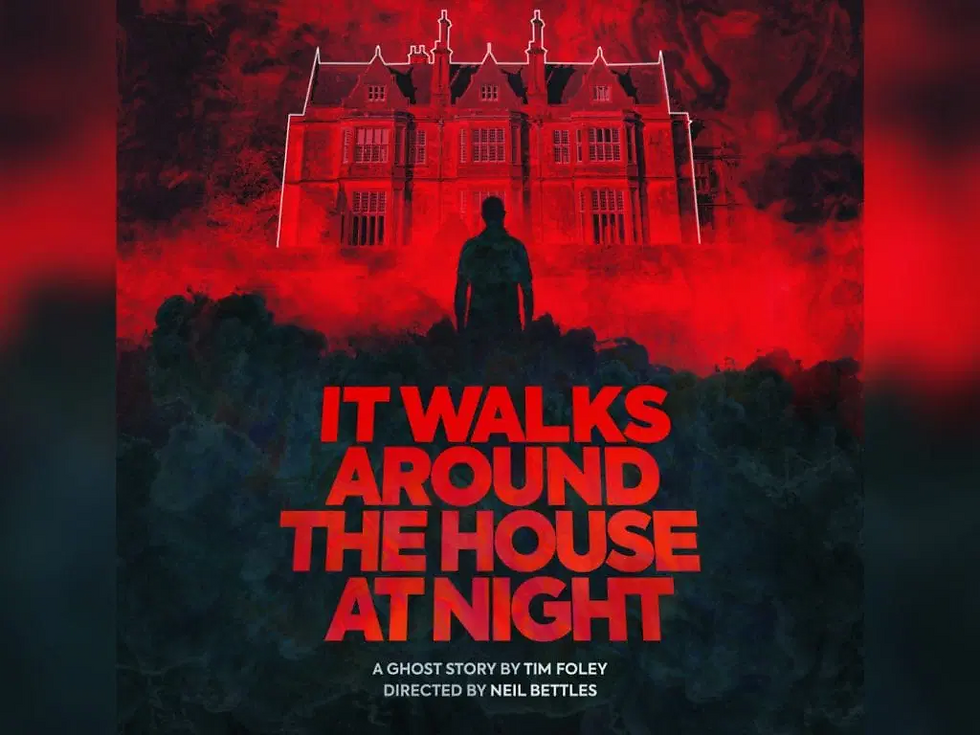
February – It Walks Around the House at Night
Venue: Chichester Festival Theatre
Theme: Haunted Houses
It Walks Around the House at Night is a contemporary ghost story rooted in one of the most enduring Gothic spaces: the haunted house. An out-of-work actor is hired to impersonate the spirit said to roam a remote country estate, only to find himself entangled in something far less theatrical and far more disturbing.
As myth, performance and reality begin to blur, the play asks why certain places seem to cling to the past, and why some presences refuse to leave. The isolated house, bordered by encroaching woodland, becomes a psychological pressure chamber. Walls listen. Floors remember. Fear does not arrive with spectacle, but seeps in gradually as the ordinary shifts out of alignment.
Here, the Gothic is not all thunderclaps and apparitions. It is uncertainty. It is doubt. It is the creeping suspicion that the role being played may not be entirely fictional.
The month’s films traced the haunted house across decades, styles and sensibilities.
In The Uninvited, a Hollywood Golden Age haunted house classic, atmosphere builds through suggestion and repression, establishing many of the genre’s visual and emotional codes. The Others transforms a grand, shadowed home into a space of grief and denial, where silence is as oppressive as any spectral presence. Burnt Offerings presents the house itself as vampiric, feeding on its inhabitants and reshaping family dynamics with quiet malice. Most recent is Presence, which reframes the ghost story through an intimate and disquieting perspective, reminding us that haunting may be as much about observation as intrusion.
Across these films, the house is never merely a setting. It watches. It absorbs. It waits.
The novels deepened the sense that architecture can carry ideology, trauma and decay within its walls. Mexican Gothic relocates the haunted house to 1950s Mexico, where colonial rot, family secrets and bodily corruption intertwine within a crumbling mansion. The building is oppressive not just structurally, but politically and historically.
In The House Next Door, horror arrives in suburbia. A newly built home becomes the epicentre of tragedy, proving that modernity offers no immunity from the Gothic. Respectability fractures; neighbours watch from behind curtains; something is deeply, fundamentally wrong.
February became a month of interiors — of corridors, staircases and closed doors. Theatre, film and fiction converged to show that haunted houses are never simply about ghosts. They are about memory, repression, performance and the uncomfortable possibility that the past is not past at all.
If January dealt in thresholds, February lingered in the rooms beyond them — and quietly suggested that sometimes it is not the house that is possessed, but the people within it. March will push that idea further, asking what happens when performance itself takes possession.
Films: The Others (2001) The Uninvited (1944) Presence (2024) Burnt Offerings (1976)
Fiction: Mexican Gothic by Silvia Moreno-Garcia The House Next Door by Anne Rivers Siddons
Bonus Gothic: The Houses of the Moors
Although not a haunted house story in the conventional sense, February also included a visit to the cinema to see Emerald Fennell's Wuthering Heights. While Emily Brontë’s narrative is rooted in obsession rather than apparitions, the houses themselves — Wuthering Heights and Thrushcross Grange — are absolutely central. They shape behaviour, encode class division and intensify emotional extremity.
The Heights is elemental, exposed, battered by weather and temperament. The Grange is ordered, refined and quietly suffocating. Together they form a closed Gothic ecosystem in which desire curdles into possession and love becomes a form of imprisonment.
I wrote at length about this adaptation — its embrace of Gothic excess, its reframing of obsession over romance, and its provocative visual style — in a separate blog: Wuthering Heights (2026): Obsession, Desire and Gothic Excess.


Comments