A Year of Gothic - October 2026
October's A Year of Gothic turned to witches, although the month's theatrical offering was rather more playful than sinister. Across theatre, film and fiction, the focus was on women accused of witchcraft, the stories told about them and the ways in which witchcraft has been used to express wider fears about female power and independence.
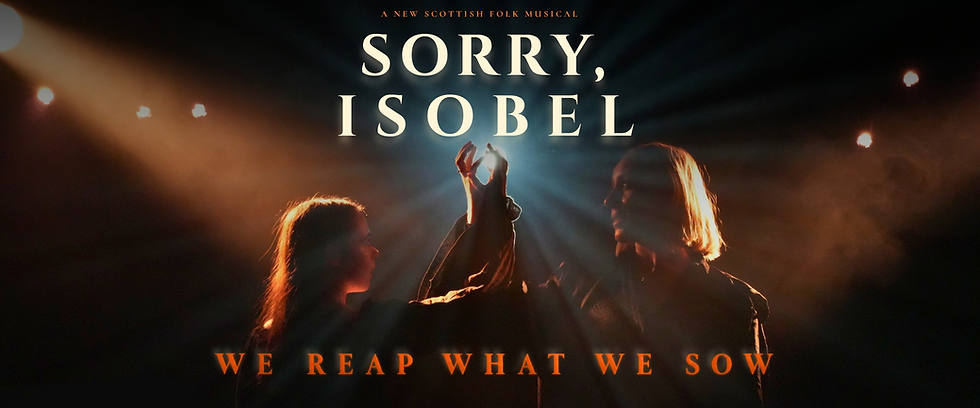
October's central production was Sorry, Isobel at the Drayton Arms Theatre. A new musical inspired by the story of Scottish witch Isobel Gowdie, it has book and lyrics by Heather Gourdie, who also plays Isobel. Rather than taking a dark or particularly Gothic approach, the production uses comedy to revisit the familiar roles of accuser and accused, and to explore how the stories of women accused of witchcraft have been recorded and retold. It was a work-in-progress production, running for just over an hour, and I enjoyed it. It was fun and had some interesting ideas, although it was perhaps not quite the Gothic theatrical experience the subject might suggest.
The four films watched explored witchcraft from rather different perspectives. Michael Reeves's Witchfinder General (1968) returns to the persecution of those accused of witchcraft in seventeenth-century England. Its brutality and the abuse of power by Matthew Hopkins make it a particularly grim account, with accusations of witchcraft becoming a means of controlling and destroying the lives of others.
Sidney Hayers's Burn, Witch, Burn (1962) brings witchcraft into a more contemporary setting, playing with the tension between rational explanation and the possibility of supernatural forces. Its familiar domestic world becomes increasingly threatening, suggesting that Gothic unease doesn't always need a distant castle or a historical setting.
Anna Biller's The Love Witch (2016) offers a much more colourful and stylised take on the subject. Elaine is a modern witch who uses spells and potions in her search for love, but her ideas about romance and femininity are rooted in fantasy and impossible expectations. The film's beautiful, deliberately artificial look contrasts with the darker implications of her behaviour. It plays with the image of the witch as both desirable and dangerous, while also questioning the expectations placed on women.
Rungano Nyoni's I Am Not a Witch (2017) takes a more unsettling approach. Set in Zambia, it follows a young girl accused of witchcraft and sent to a so-called witch camp, where the women are controlled and exploited. The film uses moments of dark humour and surrealism, but its subject is rooted in the very real consequences of superstition, social control and the treatment of women considered inconvenient or different.
Together, the films move between historical persecution, supernatural uncertainty, stylised fantasy and contemporary social commentary. They offer very different ideas of what a witch might be: a woman accused by others, someone who claims her own power or a figure onto whom society projects its fears.
The month's fiction brought the focus back to Scotland. Harriet Tyce's Witch Trial and C.J. Cooke's The Lighthouse Witches take different approaches to the legacy of witchcraft accusations and the way the past continues to affect women in the present. Witch Trial brings historical persecution into a contemporary story about justice, family and the assumptions we make about others. The Lighthouse Witches takes a more overtly supernatural Gothic route, with its remote Scottish setting, family secrets and history of witchcraft. Both connect the stories of women in the past with those who find themselves caught up in their legacy.
October wasn't quite the month of Gothic theatre I might have expected. Sorry, Isobel was an enjoyable, comic work in progress rather than a dark or unsettling production. But the contrast was interesting. Across the films and fiction, witches appeared as victims of persecution, objects of fascination, figures of fear and women attempting to claim some control over their own lives. The stories may be very different, but they keep returning to the same question: who gets to decide what makes a woman dangerous?
Films: Witchfinder General (1968, Michael Reeves), Burn, Witch, Burn (1962, Sidney Hayers), The Love Witch (2016, Anna Biller), I Am Not a Witch (2017, Rungano Nyoni)
Fiction: Witch Trial by Harriet Tyce and The Lighthouse Witches by C.J. Cooke


Comments