Adrift in Time: Boats, Loops and the Pull of the Sea
With Mark Jenkin’s Rose of Nevada in cinemas now, let’s take a quick voyage through boats, time slips and strange currents where nothing quite behaves as it should.

There’s something about boats and time travel that just works. Maybe it’s the isolation, the sense of being cut off from the world or the way the sea itself feels timeless, vast, unknowable and slightly threatening. Whatever it is, films that trap characters on the water and bend time around them tend to linger long after you’ve left them.
A good example is the Florida-set Triangle (2009, Christopher Smith), a clever, nerve-tight thriller in which Melissa George plays Jess, a single mum who joins a sailing trip that quickly turns into something far more disorientating. What unfolds is a smart, looping narrative full of dread and déjà vu, with strong support from Liam Hemsworth and Henry Nixon. It’s one of those films that keeps you guessing while quietly tying itself into knots.

Then there’s Maltese thriller The Boat (2018, Winston Azzopardi), which strips things back even further. A lone fisherman (Joe Azzopardi), a fog that won’t lift and an abandoned sailboat that turns out not to be so empty after all. Minimal dialogue, maximum tension. It leans into atmosphere and the primal fear of being lost at sea, with something unseen working against you.

More recently, the 8-part mini-series 1899 (2022, created by Baran bo Odar and Jantje Friese) expands this idea on a larger scale. Set aboard a migrant steamship crossing the Atlantic, it begins as a mystery but gradually reveals a structure built on repetition, altering realities and a deep unease about time itself. It’s less about a single loop and more about layers, but that same sense of being trapped at sea and unable to escape what’s happening runs right through it.

Into this lineage drifts Rose of Nevada (2025, Mark Jenkin), which takes a slightly different tack but feels very much at home in this strange, salt-soaked corner of cinema.
Jenkin’s distinctive aesthetic is immediately recognisable, shot on 16mm with a grainy, weathered texture that feels almost physically handled. Dialogue, sound and music are layered in afterwards, creating a subtle sense of dislocation, as if what you’re watching has already happened and you’re piecing it back together.
Set against the Cornish coast, it’s a time-slip story that leans heavily on atmosphere, drawing you into its rhythms rather than spelling things out. There’s a quiet disorientation to it that lingers, as if the landscape itself is slightly out of joint.
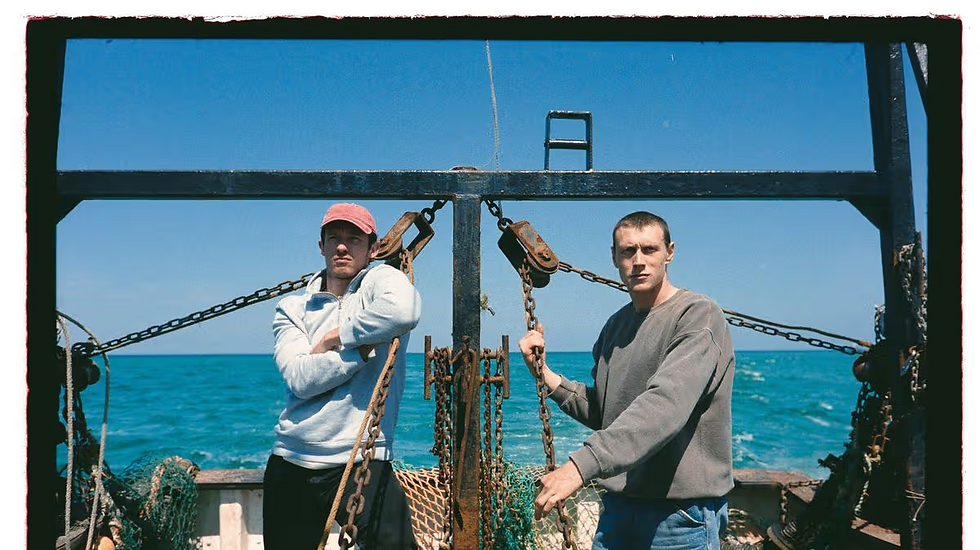
What really holds it together, though, is the contrast between the two leads, Liam (Callum Turner) and Nick (George MacKay), caught up in the shifting sands of time, place and identity. Faced with the same strange phenomenon, they respond in completely different ways, and that divergence gives the film its tension and shape, quietly pulling the story forward even when everything else feels unstable.
It’s quietly unsettling, absorbing without ever feeling overstated and one that lingers afterwards. Definitely one I’ll be returning to and adding to the ‘to discuss’ list for the Excellent Adventures: The Time Travel Movie Podcast, which I co-host.


Comments